

Hill Kourkoutis: There’s A Lair, In A Neighbourhood… Maybe Near You!


Toronto has so many interesting nooks and crannies, stories and tales, and especially talent. What one may forget, as the endless grey cold rainy days drag on during what is supposedly called spring here in Toronto, is that there are incredibly creative people shining like homing beacons through the gloom, reminding all of us that creativity and art are always here to guide us out of the darkness and into the light. And Hill Kourkoutis is absolutely one of those artists carrying the torch and lighting the way.
A colleague of mine, after reading a few of the articles I’ve put together on some great studios around Toronto, asked if I’d be interested in writing an article on Hill. "Absolutely! Yes!", I said. However, being somewhat new to writing articles, and so far mostly focusing on public studios packed wall-to-wall with crazy amounts of gear, I wondered what a visit with a producer/engineer like Hill would be like.
With the other articles, I was primarily focusing on the facilities and the people contributing to the facility as a whole and definitely the studio atmosphere. But here, Hill is the studio vibe and, to a great degree, the talent and driving force behind the songwriting as well.
THERE HAS TO BE A FIRST
For those of you who don’t know, Hill is the first Canadian woman to win a Juno Award for Audio Engineer of the Year! Hill is very unassuming and modest, and after reading a few older interviews, it’s clear she’d rather not have the focus placed solely on gender.
“My guy friends are never referred to as male producers and engineers, and I am hoping that it (gender) won’t be talked about at all when it comes to your work.”
- Winnipeg Free Press, March 14, 2022
Paraphrasing here, but Hill also acknowledged that not all barriers have been knocked down and that being taken seriously can still be difficult at times. After spending time getting to know Hill and, seeing the breadth of her work, I’d say she’s done pretty well at overcoming barriers and being taken very seriously.
THE ART LIFE
I’m quite the David Lynch fan, and there’s a really interesting documentary about him called The Art Life. The film follows David through his daily artistic routines and explores how he became such a creative filmmaker.

I think Hill is also living The Art Life.
She’s one of the only producer/engineers I know who is also highly accomplished in the visual arts realm. Early in her career she appeared as an actor on the cult television series Radio Free Roscoe. From there, she forged a parallel creative path directing music videos for artists like Sass Jordan, Alex Cuba, Mother Mother, and Serena Ryder.
Sounds like a pretty interesting person, eh?
Let’s take a visit and see where the music comes to life.
THE LAIR
There was a lot to take away from my visit with Hill. But, just for a moment, before we get into that, I’d like the reader to keep one word in mind:
Pragmatic: dealing with situations based on practical, real-world considerations rather than rigid theories or idealistic principles. Focusing on what works.
The reason I bring this up is because I really appreciate what Hill has done with treatment of The Lair recording space.
Basically… nothing!
I mean, she’s got some world class gear and I love the vibe and setup, but there are no fancy wooden diffusers or expensive sound-treatment materials all over the place. She knows what her Neumann KH310s sound like in that room, and it translates.
Please indulge me for a moment, up-and-coming producers, there’s such a great takeaway here. Focus more on your ideas and creativity. Let experience and craft settle in over time. Just do it. Don’t obsess over having the best of everything; the best mic, the best room, or the best anything really.
Granted, her KH310s are awesome monitors, but they don’t complete a great mix. It's Hill that makes the songs and mixes special.
Another bit of recording affirmation to this point, if you’ve watched The Beatles: Get Back documentary, you may have noticed that when they moved into Apple Studios there was basically no sound treatment, they were using PA speakers, and there were hardly any headphones in sight. Some of the most iconic songs in history were recorded right off the floor like that! Furthermore, Glyn Johns’ rooftop recordings sound remarkably similar to the takes from inside the studio. Just consider that for a moment. Okay, yes there’s obviously some genius involved there. But at the core of it all was simplicity and a pragmatic approach to capturing performances. Just get it done.
What was so inspirational about Hill’s approach and studio setup is that, at its core, it proves world-class recordings can absolutely be made in a home studio basement environment when talent, creativity, and experience take the wheel.
I really want to drive this point home for all the young producers and engineers I’ve met over the past few years here at LM Pro. I get asked constantly about “the best” this and “the best” that. And yes, there are great use-case scenarios for all kinds of gear. They’re tools. But tools are useless by themselves. So please! young artists, songwriters, and producers, be inspired by Hill’s process the same way I was.
Okay, I digress. Let’s talk about The Lair.
FLYING HIGH

The first thing I saw in the studio, after being so warmly welcomed, was a very cool black and white Gibson Flying V.
I’ve always been a huge Flying V fan. When I was a kid, I had a Hondo Flying V. For a 14 year old, it was alright! If I’m not mistaken, I believe this particular Flying V may belong to Serena Ryder.
Beyond the V, there’s a really sweet collection of axes: staples like a blue Strat, a Fender Jag, a Gretsch archtop, a Gibson SG (YESSS ANGUS!!), a couple lap steels, an old Gibson acoustic, and even a stand-up bass tucked in the corner, a fantastic instrument to have around.
TONES

Besides having a great arsenal of guitars, Hill also has a couple secret weapons when it comes to tone.
She swears by her TYPE MTP-66 Motown Tube Preamp. According to Hill, this unit gets used on nearly everything she records and plays a massive role in achieving some of her signature DI guitar tones.


Another little weapon in the chain is the Chroma Console Multi-Effector, a super cool-looking stompbox sitting right beside the MTP-66. Funnily enough, a friend of mine has one, and after seeing Hill’s setup I immediately told him, “Bring that thing over. I need to try it!”

Staying on the guitar side of things for a moment, Hill also has some great Fender amps, a super vintage Vox, and a precious sweet old Silvertone.
STOMPING AROUND
There’s a pretty cool collection of stompboxes as well: an MXR Phase 90 (classic), wah pedals, a RE-20 delay, MT-2 Metal Zone, tremolos, distortions, really just solid, standard-issue pedals that get the job done. And harkening back to what I mentioned earlier, these are all very attainable tools that can be collected over time.

DROPPING THE BEAT

Hill had several drum kits set up against the wall that can be mixed and matched to achieve a huge variety of sounds and tones. What I really love here is the simplicity of her drum recording approach. Hang a few cool paintings, set up some classic drum mics, keep the recording snake nearby, and go. I really love this setup. She played me several tracks and I asked, “The drums for this were recorded right there??!” And she replied, “Yep.” Haha. I absolutely love how she’s getting these massive, tasty drum sounds with such a minimalistic room approach.
Her talent and creativity as an engineer are front and centre here, but that’s really the point: a great player and a great producer can make magic happen almost anywhere.
TOOLS OF THE TRADE

Hill definitely has some great studio gear in The Lair. Handling AD/DA duties - along with some virtual mic preamp processing via Unison - is a Universal Audio Apollo x8 alongside a desktop Twin. There are some great mic pres as well, including the Warm Audio WA-2MPX dual mic preamp. Just below that in the rack is the UA 4-710d Twin-Finity, which is a fantastic unit: four tube/solid-state mic pres along with eight channels of A/D conversion. Below that sits an AudioScape V-COMP tube compressor. There are a couple versions of this unit floating around, but according to the manufacturer they both use JJ6386 tubes. Rounding out the bottom of the rack is SSL’s Fusion, an excellent stereo finishing processor capable of adding colour, depth, width, saturation, and even a touch of dynamics control.

Little pro tip here: I was recently chatting with an artist who gets tons of ad placements, and he actually prints his Marshall amp recordings through the Fusion!
You’ll also spot some great 500-series gear in her custom desktop rack, including an ACME Opticom XLA-3 and a classic dbx 560A compressor, along with a pair of Retro Instruments 500PREs. Tucked away to the left on her desktop is also a Manley Nu Mu stereo tube compressor.


For someone like Hill, a producer/engineer working at the forefront of contemporary Canadian music, the Nu Mu feels like a perfect fit. Modern, punchy, clean, but still rich and musical.
But contemporary music also draws heavily from the past, and if you want vintage, Hill’s got that covered too. How about a TEAC reel-to-reel tape machine to warm things up? You may have to ask Hill where she sources her tape, though!

TALKING TRANSDUCERS

Hill has a great monitoring setup to make sure everything sits exactly where it should in the mix. Her mains are Neumann KH310 three-way monitors. Fantastic speakers. I’ve had the opportunity to audition them several times in the shop and they sound excellent; great mids, excellent detail and separation, and very little ear fatigue. We actually had them set up in the shop beside some other three-way monitors costing nearly twice as much, and the KH310s absolutely held their own. Rounding out the monitoring setup are a pair of MixCubes, some KRKs, and a KRK sub.
THE REAL DEAL
Talking with Hill was genuinely inspiring. Not just because of the cool studio setup, but because of her energy, talent, and excitement for creativity and pushing musical boundaries. She played me several tracks from artists she’s produced and co-written with, and I started noticing a common thread: There’s a sound that is unmistakably Hill Kourkoutis.
I really loved some of her chord choices. The way a certain chord drop would lift the final third move of a verse, tie together a pre-chorus, or land a chorus with emotional weight. Very musical. And, Very unique!
Combined with her sonic aesthetic, there’s a vibe running through everything she touches, and it’s good. I mentioned this to her and asked about her childhood inspirations. She brought up artists like Sheryl Crow, The Go-Go’s, Bowie, and Motown. And suddenly it clicked. Ahhh… there it is. The secret sauce.
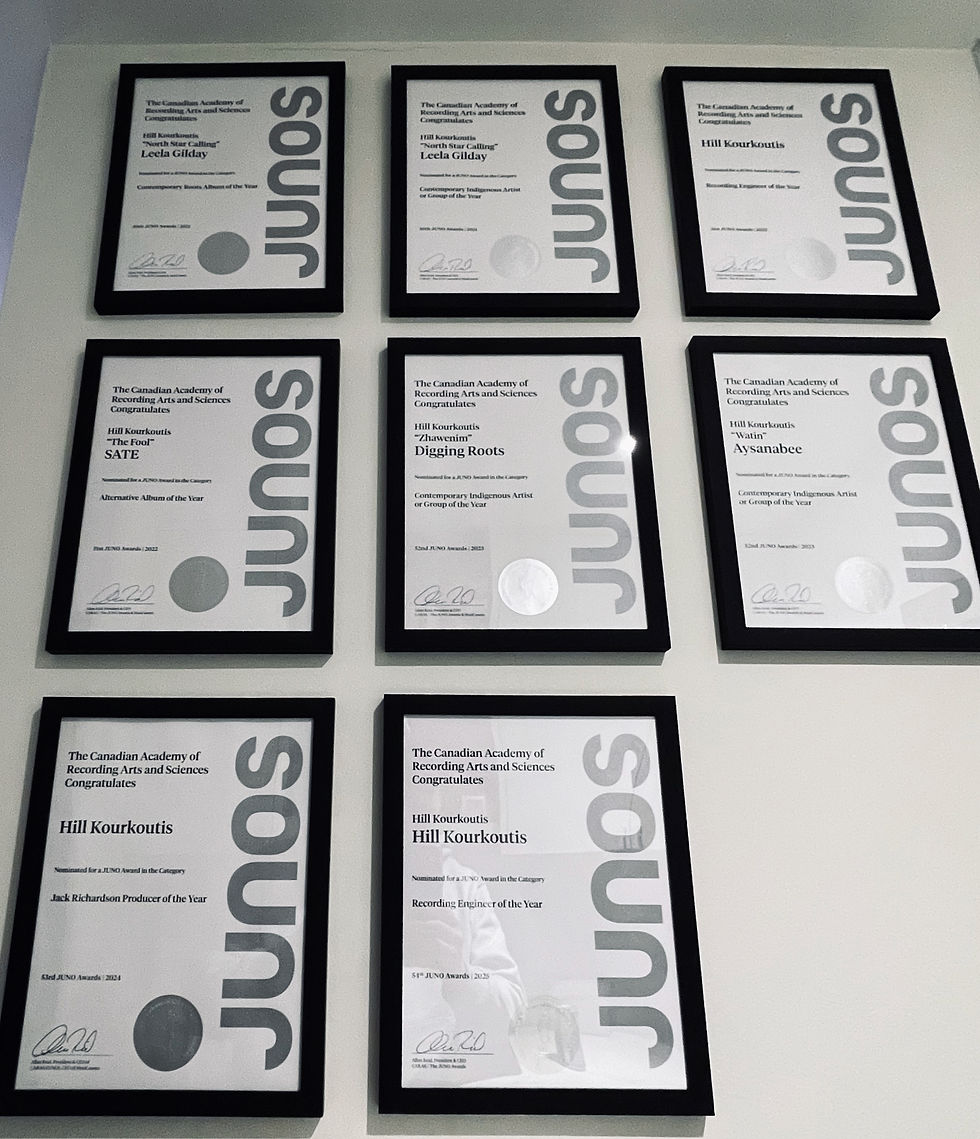
Naturally, it takes a hugely talented musical chef like Hill to bring all those influences together into something uniquely her own, but the more I listened, the more I could hear those Motown tonalities and Crow/Bowie songwriting influences subtly woven into her work. Still, none of it feels retro for the sake of retro. Hill writes for right now. And judging by the collection of Juno credits hanging on the studio wall, I’d say a lot of people are connecting with it too.
CHILL’N
It was a real pleasure getting to know Hill during the afternoon I spent at The Lair. Near the end of the visit she started handing me some of her guitars to noodle around on. I love swapping stories about gear, guitars, little quirks, and instrument personalities. My father used to own a white Fender Jag but sold it when I was born. I mentioned that while playing Hill’s Jag, and man… I really wish he had kept it!
I hope this article lights a little creative fire under your pants and inspires everyone out there in the musi-verse to keep creating, keep writing, and keep producing.
Just do it. Right now. Today. Tonight. Let’s go!!
Thanks, Hill!
As always, happy recording.
~ LM Pro


The studio profile on the Long & McQuade Pro blog provides a vibrant look at how a pragmatic, creativity-first philosophy can fundamentally redefine the boundaries of modern music production. It is incredible to see how an inside look at a Juno Award-winning producer’s home studio—utilizing raw room acoustics, versatile instrument arrays, and a minimal, focused gear setup—can provide the absolute quality work needed to capture massive drum tones and record hit tracks without the need for overly expensive, formal sound-treatment installations.
For audio engineers, independent musicians, and creative directors who value strategic production frameworks and a collaborative network to discuss emerging studio techniques, connecting with an active group like the winadda is a fantastic way to engage with others focused on…