

Bringing It Back To The Future with Chandler Limited


Exploring Chandler’s TG, Abbey Road and EMI Lines
If you’re in the audio recording industry, then in many instances you’ve undoubtedly come across some of the coolest gear by Chandler, including its legendary icons and labels like Germanium, Abbey Road, TG, REDD, EMI, and TG. There’s much here that evokes the golden era of recording—the era of recording magic! And that is, of course, The Beatles’ Abbey Road era. One could also argue that Pink Floyd’s Dark Side of the Moon belongs in that conversation.
So, you’re online—preferably in our shop, because we have a bunch of this gear hooked up so you can hear it!—checking out some Chandler stuff and, if you’re like me, you must have wondered at times what exactly does the extra labeling really stand for: EMI, Abbey Road, TG, 12345… Okay, obviously we’ve all heard of Abbey Road and EMI, but what exactly are we referring to here? What is REDD, and how is it different from TG? What does TG even stand for?

Before you read any further… please guess! It’s not Top Gear… Transistor Gain?
Rupert Neve’s Focusrite preamps were called ISA simply and pragmatically for “Input Signal Amplifier.” So, for Chandler TG, what did you guess? Transformer Gain?
Well, here it is: The Gramophone Company
Yup, nothing to do with the development of modern compressors, EQ or mic preamplifiers specifically. But, hang on, there’s an interesting story here.
As it turns out, way back in the day—like way back in the 1930s—the Gramophone Company merged with Columbia Records to form EMI. Apparently, those guys really liked their acronyms; EMI stands for Electronic and Musical Industries.
Back in those days, the people working for the Gramophone Company must have had really nice bosses because they kept their allegiances and went by "TG men." And thus, the TG moniker continued for many decades, and they’re still using it! We’ve sorted through a couple of the basics: TG and EMI. Keep track, because there might be a pop quiz later. ;)
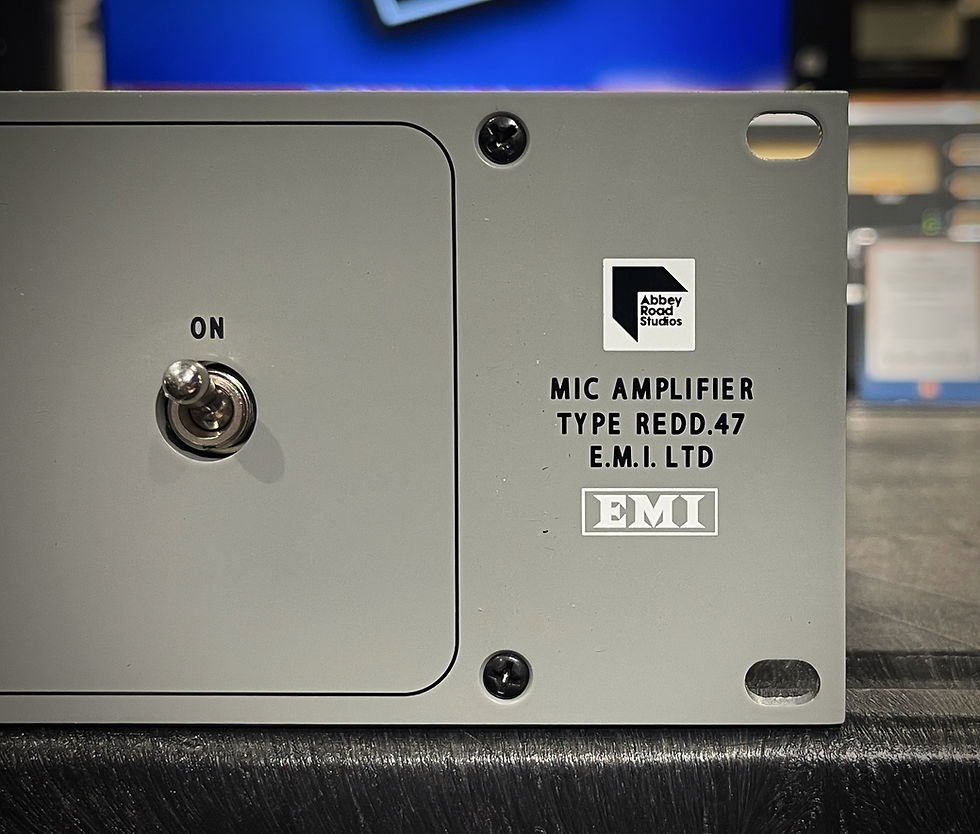
So, have you found yourself perusing through our shop, and did that huge, sexy Chandler REDD Mic catch your eye? And ears?! The online demos and reviews are just fantastic! But hang on a second, what is REDD? Care to fashion a guess again?
Well it’s: Record Engineering Development Department
So, if you’ve acquired a REDD product from Chandler, rest assured, you got it from the correct department.
The REDD desks were valve (tube) based, with the first, the REDD.37 being put into production at Abbey Road around September 8, 1960. The following version was the REDD.51 which used proprietary-developed REDD.47 mic pres that replaced the German Siemens V72 amplifiers. From this, we see that the Chandler REDD.47 mic pre is a recreation of the mic pre found in the EMI REDD.51 desk.
Curiously, although the TG men were presumably there the whole time, they waited until after the REDD.51 to introduce the TG console. As mentioned earlier, the REDD desks were all valve 4-track units, so the TG marked quite a philosophical shift to the 8-track transistor architecture.

The TG12345, being transistor rather than valve, also had channel compression/limiting, as well as more sophisticated EQ and expanded routing. Most notably the TG12345 was used on The Beatles “Abbey Road” and Pink Floyd’s “Dark Side of the Moon.” The TG desk was smooth and lush sounding.
At the time of development, the TG men were still very much around and were directly involved with developing the new console. However, they needed to give this new console a name, so rather than spending more than two minutes after lunch coming up with something unique, they did what any fastidious engineering scientist types would do: they just assigned a placeholder name. Similar to writing “password” for password, they just jotted down “12345,” and it stuck! The TG12345, also known as the Mark I, was born!
Other versions of the TG12345: the Mark II, III, and IV were synonymous with the Abbey Road Studios through the 1970s.
So, now when we look at Chandler’s TG12345 Curve Bender EQ, we know where the TG and 12345 came from. EMI and Abbey Road were one and the same back in those days.
If you were a fan of that partnership, you would have been able to brag and celebrate it up to 2012 when the corporate entities split and went their separate ways.
Finally, I think we can put Chandler TG/EMI/Abbey Road products into perspective and unpack what the units represent.
MIC PREAMPLIFIERS & EQ
REDD Mixing System - Developed in collaboration over six years with Abbey Road, the REDD mixing system is a completely modular system that combines REDD.51 Valve and TG12345 transistor console architecture.
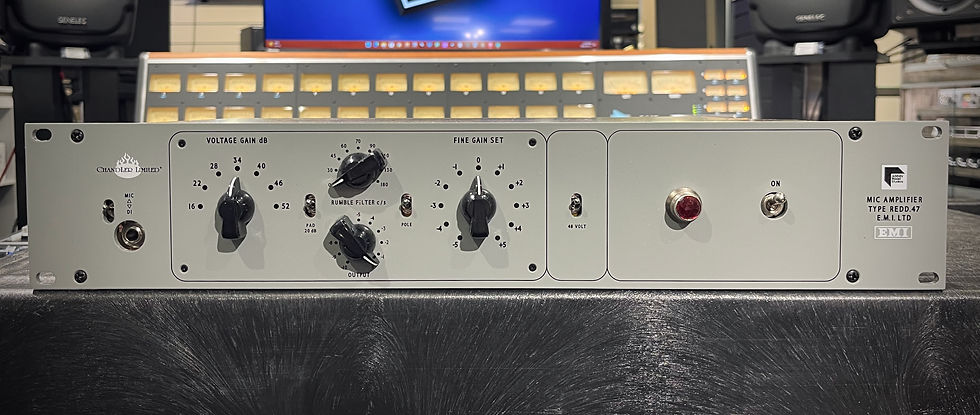
REDD.47 Mic Preamp - A valve mic preamplifier that is a faithful recreation of the proprietary EMI mic pre that was found in the REDD.51 desk
Abbey Road EMI TG12345 Curve Bender - Conceived by Chandler Limited designer Wade Goeke, based on the vintage EMI TG12345 desk that was used to record The Beatles Abbey Road and Pink Floyd’s Dark Side of the Moon.
*Please note there are a couple of small contradictory historical facts between Abbey Road and Chandler regarding the Curve Bender lineage on this one:
According to Chandler, “EQs started in 1954 with the RS57, the 1969 TG12345, and the 1974 TG12412.” — Chandler Limited
However, on the Abbey Road website, the original “Curve Bender” was the passive RS-56 UTC. They say that the lineage to the Chandler Curve Bender starts there and that Abbey Road engineers nicknamed it the “Curve Bender” for its ability to shape a sound.
Please follow this link for more info on the Curve Bender:https://www.abbeyroad.com/news/the-curve-bender-gearthatmadeus-3180

TG2 Mic Preamp - Can be looked at as part of the TG microphone preamp lineage, not simply as a 12345 copy. Rather, the TG2 derives from a broader EMI TG amplifier lineage.
TG2-500 - Described as deriving from the rare EMI TG12428 preamp associated with the TG12345 and TG12410 family

TG12411 Channel Strip - Draws its name and architecture directly from the EMI TG12411 Input module which served as the front-end cassette for the legendary TG12410 Transfer Console used across Abbey Road’s mastering suites.

DYNAMICS

TG1 Limiter - A direct recreation of the TG12413 limiter found in the TG12345 consoles. They were looking for something as smooth as the Fairchild 660 but still wanted to retain punch and sonic character.
This unit also has THD mode which bypasses the compression entirely and processes the signal purely for harmonic saturation. And it is a good harmonic saturation indeed!


TG Opto (500 Series) — Taken from the TG Microphone Cassette Channel Strip
“EMI technical engineers experimented with the use of optos in their audio compressors, and now for the first time ever, Chandler Limited introduces the TG1 Opto compressor.” — Chandler
Chandler RS124 (Valve) - A recreation of Abbey Road’s modified proprietary version of the Altec 436 tube compressor by Head of Tech Bill Livy, Len Page, and Mike Batchelor. Its sonic signature is present on nearly every Beatles session — it’s the magical sonic glue that has been sought after since that magic period of Beatles sonic sorcery!

Chandler RS660 (valve) — A transformer-balanced tube compressor/limiter that basically takes the Fairchilds that were at Abbey Road/EMI into the modern age. It uses a 6386 valve that is tuned to enhance the richness of the 660 and beyond.

Zener Limiter - Based on the EMI TG transistor solid-state architecture of the TG12345 console limiters. This unit features expanded controls and additional flexibility.

MICROPHONES

TG Microphone - A solid-state large-diaphragm condenser mic. We know what TG stands for, but this mic has a little secret!
That’s the NAB/IEC tape EQ settings found in the TG12410 Transfer Console. Offering various scenarios that may emulate tones from other pro mics, System A is mid-forward, typical of TG, and System B’s voicing is more pristine and capable of higher SPLs… think FET47.

REDD Microphone - Custom-designed by Chandler from the ground up, the REDD Microphone features a built-in REDD.47 valve mic preamplifier, completely eliminating the need for an external preamp.

Chandler maintains that creating the shortest possible distance between the custom platinum capsule and the valve preamp circuit is what delivers its signature larger-than-life full-bodied sound.
Developed in close collaboration with Abbey Road, the microphone underwent extensive prototype testing, with former Chief Engineer Peter Cobbin noting that the REDD microphone excelled even when shot out against the studio’s legendary house stock of vintage classics.

So, there you have it, Chandler and EMI, Abbey Road, and TG!
I hope the designations, history, and lineage has become clearer and helps to inform your studio gear curiosities and choices.
As always, happy recording!
~ LM Pro



Comments