

Where Code Meets Sound: How Computer Science and Audio Engineering Come Together Through AI


Introduction
As someone who has studied computer science and worked in audio engineering, I’ve seen how these two worlds — one focused on logic and data, and the other on art and emotion — are now more connected than ever. Today, artificial intelligence (AI) acts as the bridge between them, allowing computers not just to record and edit sound, but also to understand and even create it.
The fusion of these fields is changing how we produce music, design sound, and experience audio in everything from films and games to everyday apps.
1. How Computer Science and Audio Engineering Are Connected
At first, computer science and audio engineering might seem very different. But when we look closely, both deal with patterns — one in data and the other in sound waves.
Digital Signal Processing (DSP)
In modern audio production, sound is no longer handled as pure vibrations in air — it’s converted into digital signals made of numbers. Digital Signal Processing (DSP) is the science of manipulating these signals using algorithms.
When an audio engineer applies an equalizer, reverb, or pitch correction, what’s happening behind the scenes is advanced computation — mathematical formulas written in code.For example:
An equalizer adjusts frequencies using mathematical filters.
Compression controls loudness using algorithms that measure and limit peaks.
Reverb simulates reflections of sound using convolution or delay algorithms.
These techniques rely on computer science concepts such as Fourier Transforms, data sampling, and real-time computation.
Software Development for Audio
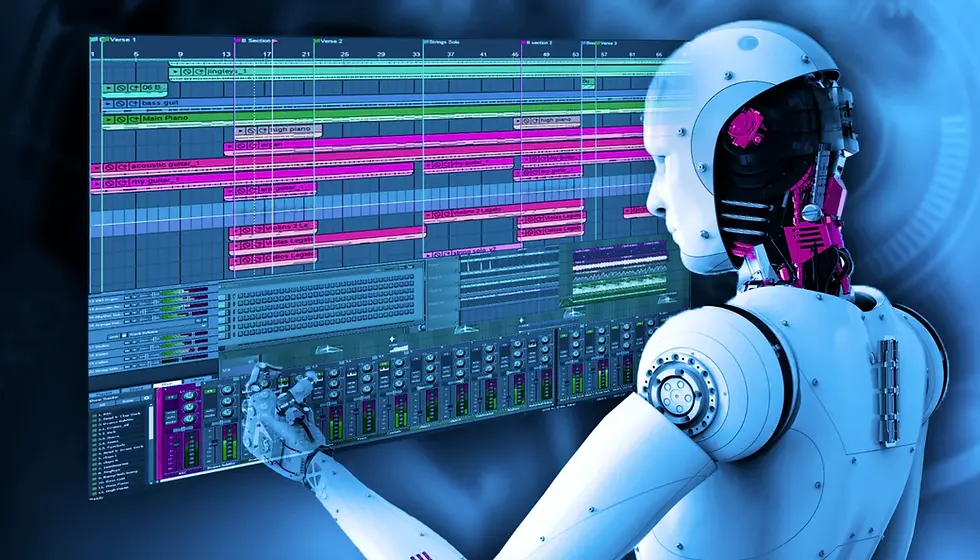
Most of the professional tools used by audio engineers — like Pro Tools, Ableton Live, or FL Studio — are built by computer scientists. Writing efficient, real-time software requires expertise in C++, Python, or frameworks like JUCE.
From my own experience, when I coded a simple reverb effect using Python, I realized that every control in a digital audio workstation (DAW) — every “knob” or “slider” — is ultimately a piece of code performing precise calculations.
2. How AI Is Merging the Two Fields
AI has taken the connection between computer science and audio engineering to a completely new level. Instead of just processing sound, AI systems can now learn from it.
AI in Music Production
Modern tools like iZotope Neutron or Ozone use machine learning to analyze songs and automatically suggest EQ, compression, and mastering settings. As an audio engineer, this helps me save time and get a professional mix faster. As a computer engineer, I find it fascinating that these systems learn from thousands of songs, finding patterns in frequency balance and dynamics that match human taste.
AI in Music Creation
AI is also becoming a creative partner. Projects like OpenAI’s Jukebox, Google Magenta, and AIVA can compose original music in the style of famous artists or genres. When I first used Magenta to generate chord progressions, I realized something powerful: the model wasn’t just copying — it was learning musical logic. It understood rhythm, melody, and harmony through data, showing that creativity can be modeled computationally.
AI in Voice and Speech
Voice-based technologies also combine both fields beautifully. AI models like Whisper (speech recognition) or VALL-E (voice synthesis) analyze massive datasets of human speech. They can now transcribe, translate, and even clone voices with astonishing realism. For example, AI can make a virtual assistant sound more natural or help restore old recordings where the original audio is damaged.
AI in Sound Restoration
Restoring noisy or old audio was once a long manual task. Now, tools like Adobe Enhance Speech and iZotope RX use AI to clean recordings automatically by separating voice from background noise. This isn’t just convenient — it’s transformative, allowing creators to focus on artistic choices rather than technical cleanup.
3. Real-World Examples of This Fusion
Gaming and Virtual Reality: In immersive experiences, AI-driven audio engines like Wwise adjust the environment’s sound in real time. For instance, if a player moves into a cave, AI changes the reverb and echo to match the surroundings.
Music Streaming Services: Platforms like Spotify and Apple Music use AI to analyze the sound features of songs — such as tempo, rhythm, and mood — and recommend music that suits each listener’s taste.
AI Music Collaboration: Tools like LANDR for mastering or Endlesss for live collaboration use AI to analyze and enhance mixes on the fly. This makes high-quality production more accessible to independent artists.
4. The Future: A Collaboration Between Human and Machine
As both a computer scientist and audio engineer, I believe the future of sound lies in collaboration between human creativity and intelligent systems. We’re already seeing early signs of:
Smart DAWs that learn a user’s workflow and suggest improvements.
AI mixing assistants that replicate a producer’s unique style.
Generative sound design tools that create entirely new timbres using AI.
But the most exciting part is that these technologies don’t replace human creativity — they enhance it. The human ear, emotion, and intuition remain central, while AI takes care of the repetitive or highly technical tasks.
Conclusion
Computer science gives us the logic and algorithms, while audio engineering gives us the emotion and art. Together, with the help of AI, they form a new language where code becomes sound and sound becomes data.
In my own journey, I’ve learned that writing code for sound isn’t just about technology — it’s about shaping experiences, creating emotions, and exploring new possibilities for how humans and machines can make music together.
AI has become the perfect bridge between these two worlds — transforming the way we hear, create, and understand sound in the digital age.

Comments